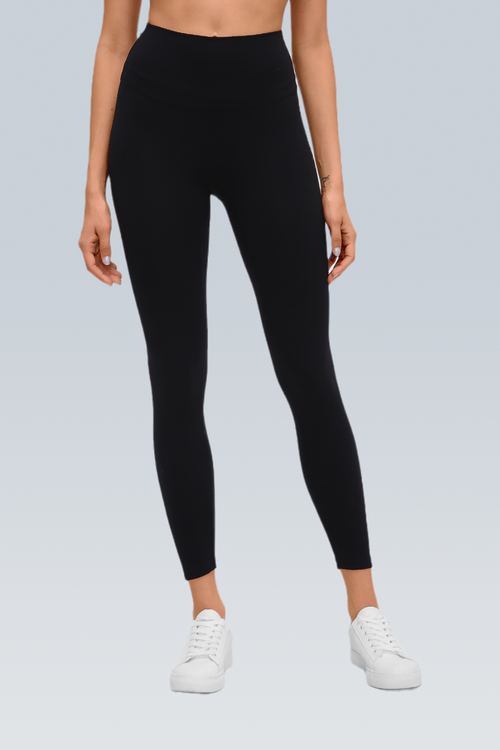
Seamless vs Regular Leggings: The Complete Guide (2026)


Updated May 2026 — The seamless vs. regular leggings debate keeps coming up in gym communities. Here's the definitive breakdown based on construction, performance, and real-world testing.
What Does "Seamless" Actually Mean?
Seamless leggings are knitted as one continuous piece on a circular knitting machine. Unlike cut-and-sew (regular) leggings — where flat fabric panels are cut from rolls and stitched together — seamless construction creates a 3D garment with virtually no stitched seams.
"Virtually" because even seamless leggings have some construction points (waistband join, gusset reinforcement), but the main body — thighs, glutes, calves — has zero stitched seams against your skin.
The Core Differences at a Glance
| Feature | Seamless | Regular (Cut-and-Sew) |
|---|---|---|
| Construction | Knitted as one piece | Flat panels stitched together |
| Comfort | Second-skin, zero chafing | Seams can dig in during deep movements |
| Stretch | 360° built-in stretch | Limited by seam flexibility |
| Durability | No seams to split under tension | Seam bursting possible at stress points |
| Opacity | Can engineer double-knit zones | Uniform thickness throughout |
| Aesthetics | Clean, smooth, modern | Visible stitch lines, more structured |
| Price | Higher (specialized machinery) | Lower production cost |
| Compression zones | Variable — tighter/looser areas engineered in | Uniform unless paneled differently |
Comfort: Why Seamless Wins for Long Sessions
The biggest real-world difference is comfort during extended wear. Here's why:
- No inner-thigh seam — the #1 chafing point during squats, lunges, and cycling is eliminated
- No waistband seam digging — seamless waistbands are knitted wider, not folded over with a stitch line
- No back seam irritation — matters during long yoga sessions or seated work
- Consistent pressure — no tight-at-seam, loose-between-seam feeling
If your workouts are under 30 minutes, you might not notice the difference. For 60+ minute sessions — especially yoga, cycling, or leg-focused lifting — the lack of friction points becomes significant.
Durability: Where Do They Actually Fail?
Regular leggings fail at seams
The stitching is the weakest point. During a deep squat or lunge, the inner-thigh seam takes maximum stress. Over time (or sometimes immediately with cheap pairs), the thread breaks or fabric tears along the stitch line.
Seamless leggings fail at knit tension
Without seams, the failure mode is different: the knit itself can develop runs or thin spots if the fabric quality is poor. However, quality seamless knit (230gsm+ nylon-spandex) is extremely durable because the stress distributes evenly across the entire fabric rather than concentrating at seam points.
Bottom line: Quality seamless outlasts quality cut-and-sew for high-movement activities. But cheap seamless (thin knit) can fail faster than well-made cut-and-sew.
When Regular Leggings Make More Sense
Seamless isn't always better. Choose regular/cut-and-sew when:
- You need specific panel designs — mesh inserts, color-blocking, pockets
- Extreme compression — medical-grade compression leggings need seamed panels for targeted pressure
- Budget priority — good cut-and-sew is cheaper to produce than good seamless
- Running in cold weather — some thermal leggings use fleece-lined panels that require cut-and-sew
- You want pockets — side pockets almost always require seamed construction
When Seamless Is the Clear Winner
- Squats and deadlifts — no seam burst risk at maximum stretch
- Yoga — zero irritation in sustained poses
- Cycling/spin — no inner-thigh chafing during high cadence
- All-day wear — the second-skin feel works from gym to errands
- Hot yoga/HIIT — fewer material layers = better breathability
- Under dresses/skirts — invisible under clothing due to smooth finish
Our Seamless Collection: All Fastarry seamless pieces are knitted on circular machines with 4-way stretch nylon-spandex.

Contour Seamless Scrunch Legging
Seamless + scrunch — $22.00
AirCloud Camel Toe Free Legging
No front seam, buttery soft seamless — $18.00
Active Seamless Short
Seamless shorts — $15.00The Opacity Question: Which Is More Squat-Proof?
This depends entirely on fabric weight, not construction method. However, seamless has an advantage: manufacturers can engineer thicker knit zones exactly where you need opacity (back panel, gusset) without making the entire legging heavier.
With cut-and-sew, the fabric is uniform thickness — so if the back panel is 200gsm, the calves are also 200gsm even though they don't need it.
Rule of thumb: Regardless of construction, look for 230gsm+ in the glute/thigh area for reliable squat-proof performance.
How to Choose: Decision Framework
Ask yourself these three questions:
-
What's your primary activity?
- Lifting / Yoga / Cycling / HIIT → Seamless
- Running (needs pockets) / Casual / Layering → Either works
-
How long are your sessions?
- 60+ minutes → Seamless (comfort compounds over time)
- Under 30 minutes → Doesn't matter much
-
What's your chafing tolerance?
- Sensitive skin or high-rep inner thigh movement → Seamless
- Never had issues → Either works
Care Differences
Both types follow similar care rules, with one key difference:
- Both: Cold wash, inside out, no fabric softener, air dry or low tumble
- Seamless-specific: Avoid washing with garments that have zippers, hooks, or velcro — these can snag the smooth knit surface and create pulls that are more visible without seams to break up the fabric
- Cut-and-sew-specific: Check seams regularly for early thread loosening — catching it early prevents full seam failure
FAQ
Are seamless leggings less supportive?
No. Seamless technology can create variable compression zones — tighter around the waist, supportive through the thigh, lighter at the calf. The knitting machine controls tension per zone, which is actually more precise than uniform-panel cut-and-sew.
Do seamless leggings last as long as regular ones?
Quality seamless leggings (230gsm+ nylon-spandex) typically last longer because there are no seams to fail under stress. The main durability risk is pilling from friction, which proper care prevents.
Can you see through seamless leggings easier?
Not if the gsm is adequate. Some budget seamless brands use thin single-knit fabric (under 180gsm) that is see-through. This is a fabric quality issue, not a seamless construction issue. Look for double-knit seamless at 230gsm+.
Why are seamless leggings more expensive?
The circular knitting machines are specialized and expensive equipment. Each pair takes longer to produce than cut-and-sew, and the nylon-spandex yarn used for quality seamless is pricier than polyester. However, the cost difference (typically $5-15 retail) is offset by longer lifespan.
The Verdict
For gym, yoga, and active use: seamless wins on comfort, durability, and performance. For budget purchases, casual wear, or when you specifically need pockets/panels: cut-and-sew remains a solid choice.
The "seamless vs regular" question is really a "what are you using them for" question. Match the construction to your activity and you'll always make the right pick.